

The Unmentionable Genocide
An undesirable anniversary; the abortion referendum put into context

That Awful Day
The stone walls of the castle stand,
ancient witnesses to the turning of tides,
but tonight the air is thick with a strange, jagged fever.
Dublin, once grey and stoic,
is washed in a sudden, violent light,
a celebration that spills out like wine on cobblestones,
sticky, sweet, and stained.
They are dancing—
oh, they are dancing with a frantic, rhythmic hunger,
limbs flailing in a choreography of relief,
faces upturned, flushed with the heat of the victory.
Grandmothers and daughters,
men with sharp eyes and open mouths,
their laughter rising like a flock of birds
escaping a cage they never realized they held.
It is a Colosseum of the modern age,
where the roar of the crowd vibrates through the marrow.
The thumb of the consensus has dipped,
a swift, downward motion,
and in that descent, the decree is signed in invisible ink.
The invisible, the small, the quietest of all—
they are fed to the arena,
thrown to the unseen beasts of progress,
while the cheers swell to drown out the silence
of a heartbeat that will not be allowed to echo.
There is a cruelty in this exuberance,
a dehumanization so absolute it glitters like a polished blade.
They toast to autonomy, to the shedding of burdens,
yet they do not hear the phantom cries,
the muffled sounds of lives deemed inconvenient,
dampened by the thunder of feet stomping on the pavement,
dampened by the sheer, unbridled noise of those who celebrate
the very thing they have chosen to erase.
It is a carnival of the discarded,
where joy is bought with the currency of absence.
And under the shadow of the castle,
the city turns its back on the small,
leaving only the rhythm of the dancing crowd
and the heavy, hollow ache of what was silenced
to sustain the rhythm of the night.
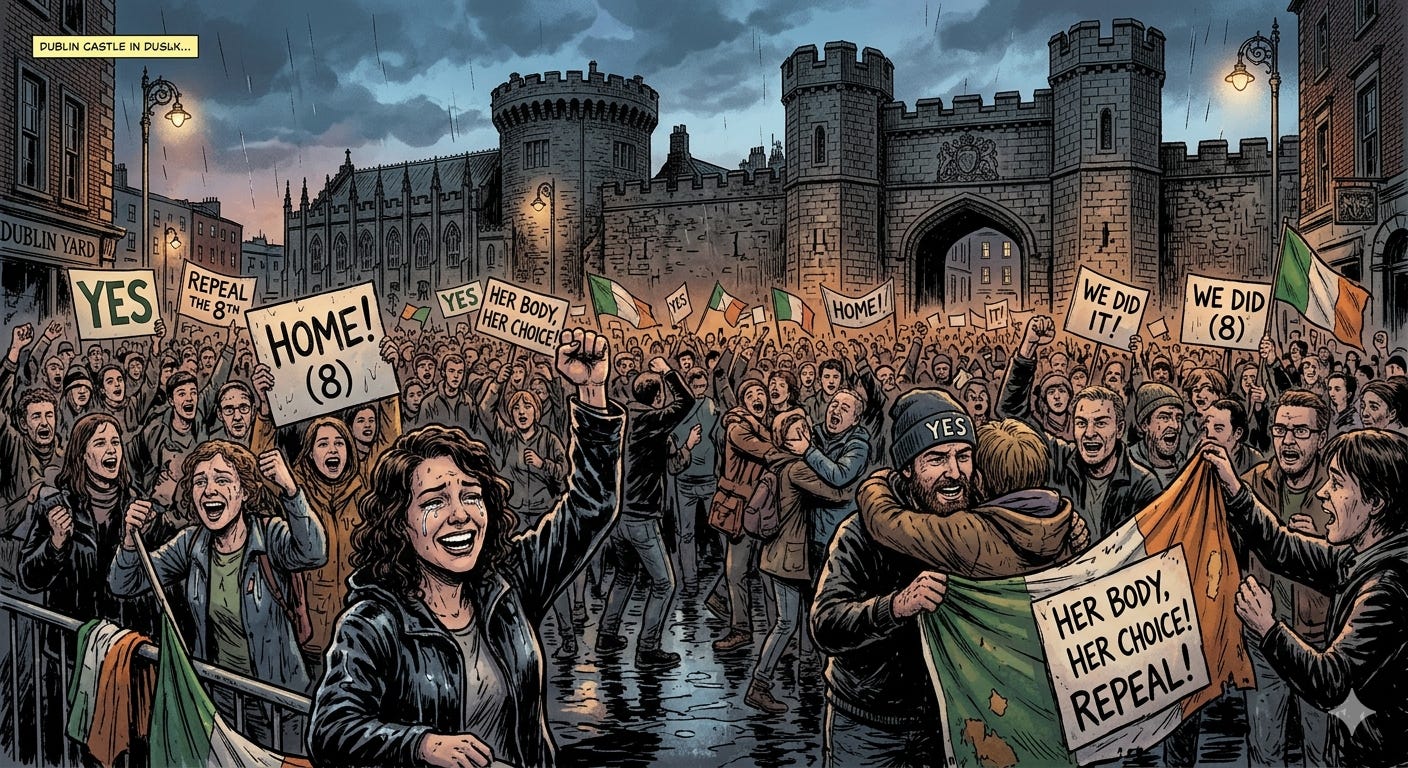
This week, eight years ago, Ireland witnessed one of the most disgusting events in its history; the celebration of the impending killing of thousands of defenceless children. This atrocity will be remembered, in time, with shame not victimhood. There will be no convenient British villain to blame it on. This was a coordinated, well financed assault on the very soul of the nation. Those who voted to kill the most innocent, and those who couldn’t careless and didn’t vote at all, cannot deny their own complicity in the most horrendous episode of carnage that will ever be recorded in the annals of this once faithful land. Since abortion was made legal in this country, over 70,000 babies have been brutally killed in the name of ‘progress’. Every ballot cast in ignorance has been stained in the blood of the innocent and many will reject the accusation because the truth is far too unsettling. The result started well before that date when propagandists posing as objective journalists were priming their audience well in advance to usher in pure, unadulterated, evil.
The ground was prepared, indeed, long before any referendum was called; with Irish Times contributors functioning not as commentators on a public debate but as architects of the emotional and conceptual terrain on which that debate would later be staged. Fintan O’Toole’s columns are illustrative —framing retention of the Eighth as a form of post-colonial psychological dependency on England, a move that deployed the appeal to identity and national self-image to make the pro-life position psychologically untenable for the target readership before a single argument about the unborn had been made, while simultaneously pre-emptively delegitimising opposition voices by warning of a “fake-news firestorm” from the No side, a framing device that inoculated the readership against No-campaign arguments by classifying them as disinformation in advance of their being made —a textbook example of the genetic fallacy weaponised as anticipatory censorship. As regards to the well rehearsed stories of women travelling to Britain to kill their unborn children, the grim story conveniently ended without the finale; the dismemberment of the child.
Una Mullally, who was simultaneously a Yes campaigner and an Irish Times contributor —an ostensible conflict of interest the paper treated as unremarkable —consistently employed false dichotomy, presenting the pro-life position as the preserve of “a cabal of fringe fundamentalists” while constructing the Yes vote as the authentic expression of the entire Irish people, erasing the substantial minority opposition through rhetorical absorption. Social affairs correspondent Carl O’Brien’s work on abortion access for migrants employed begging the question as its structural load-bearing device, presupposing abortion as healthcare entitlement and denial as discrimination, so that the entire moral question —whether the unborn child has a life worth protecting —was smuggled past the reader inside a framework of equality and access that treated the conclusion as given.
The Together for Yes campaign’s deliberate pivot to the language of “care, compassion and change” was mirrored in media coverage that adopted the same register, with the effect that the emotional vocabulary of the debate was set entirely by one side while the other was systematically characterised as extreme, the appeal to emotion doing the work that argument was never required to do. Pro-life leaders noted near-total media bias, observing that the exit polls showed many people had voted against the Eighth on the basis of claims that it was killing or seriously harming women —claims that the Health Minister and Taoiseach had themselves propagated —meaning that a vote taken on a false empirical premise was treated as a democratic mandate,
The overall architecture was one of layered priming —identity priming through the post-colonial frame, emotional priming through the personal testimony genre, authority priming through the alignment of political establishment and media, and inoculation priming through the pre-classification of opposition arguments as bad-faith disinformation —so that by the time the formal campaign began the readership had been comprehensively prepared to experience the Yes position as compassion, reason, and modernity, and the No position as atavism. No argument made within that pro life frame, however technically sound, could reach an audience that had been emotionally positioned to receive it as the voice of a rigid and cruel past. The false equivalence made between men with no faith and the faith had achieved a lot of work a decade before so the Catholic objective moral voice was neutred to the point of silence. All what was necessary then, to accomplish the end, was the reportage of an event to maximise the emotional priming. The case of Savita Halappanavar provided such an opportunity.
The death of Savita Halappanavar was cynically instrumentalised before the relevant investigations had concluded with a narrative set in advance of the evidence. The evidence subsequently showing that the proximate cause of death was sepsis mismanaged through systemic failures in monitoring and escalation. In addition, failures were rooted in part in clinicians who had collapsed the critical distinction between termination of pregnancy (which includes caesarean section and expedited delivery) and that of direct abortion (in which foetal death is the object of the act or the means by which the therapeutic effect is achieved. This distinctionm which is not a theological nicety but a structural and intentional one, demonstrates, most devastatingly by the treatment of neonates who survive failed abortions and are denied care, reveals that the object was always foetal death. The maternal health framing was mere post-hoc rationalisation, meaning that the delay in Savita’s case —itself a product of conceptual confusion was then used to advocate for the very thing that never was and never could have been the clinically indicated remedy.
The misdirection towards direct abortion was pivotal, with the institutional delay and abortion access being entirely distinct categories, the former requiring improved clinical competence and sepsis protocols, the latter addressing no clinical problem whatsoever but serving an entirely political function. The media coverage had suppressed the termination-abortion distinction, systematically ignored maternal deaths attributable to abortion procedures and the underreporting built into how such mortality is coded, and applied a standard of newsworthiness so asymmetric as to constitute advocacy. Meanwhile the biological fact that every abortion produces a dead human being was never engaged with honestly, exposing the phrase “safe, legal and rare” as internally incoherent —safe for whom after all? given one party is necessarily killed, and rare for what reason? if the procedure is merely routine healthcare —a phrase that can only be sustained by treating the exclusion of the unborn from moral consideration as a settled premise rather than the central contested question.
Into this landscape Archbishop Eamon Martin stepped forward, days after the referendum result, on national television, to echo carelessly that same incoherent formulation, operationally dehumanising the unborn child by deploying language that conceded the entire moral terrain while performing episcopal realpolik. It was another unfortunate compromise by a persistent and morally weak episcopate functioning not as a prophetic institutional voice maintaining a distinct position but as the manageable churchman the dominant framework required. The statement was shameful, and cited as evidence, wrongly, that even the Church, rightly understood, does not fundamentally object —thereby legitimising the outcome, neutering institutional opposition, and illustrating with precision the pattern by which institutions are captured (perhaps not through frontal assault but through the gradual internalisation of hegemonic framing until capitulation becomes indistinguishable from pastoral sensitivity). It was a perfect storm of institutional convergence over ideological committments, and a feckless defence by those ordained to defend the truth. There were, of course, many brave clergy and lay people who did their level best to preach the truth.
The abortion referendum eight years ago will certainly go down in history as one of the most manifestly obvious examples of mass propaganda to achieve ideological ends the country has ever witnessed. The fact that many of these Yes campaigners can continue to talk today about the risk of death and dismemberment for the children of Gaza, or complain about interred skeletal remains in Tuam whilst simultaneously engaged in a process of mass dehumanisation is the most pronounced example of cognitive dissonance on a grand scale, the country, if not the entire West, has ever experienced.
Let me take this brief opportunity to explain the nature of the atrocity by logically dismantling the pro-abortion lies and falsehoods; as well will as explaining why the Irish abortion campaign, and continued campaigns by the United Nations on an international scale—as well as those of advocating agencies —are, in fact, complete inversions of human rights as an internally consistent discipline, inversions that have led to scales of persistent mass atrocity unwitnessed before in human history.
The logic is clear. A first principle of mammalian reproduction is that females gestate offspring conspecific with themselves. A lioness carries lion cubs; a chimpanzee, a chimpanzee infant; a human, a human embryo. This is not a contested empirical proposition but a definitional feature of sexual reproduction: the zygote formed at fertilisation is a genetically distinct organism belonging to the same species as its progenitors, possessed from that moment of a unique diploid genome continuous with the parental species. The argument proceeds formally:
Syllogism 1 —The Human Embryo as Human Being
Major premise: Female mammals gestate embryos and foetuses conspecific with
themselves.
Minor premise: Homo sapiens is a species of mammal.
Conclusion: A pregnant human female gestates a human embryo or foetus —a
genetically distinct, living member of the species Homo sapiens.
This conclusion is not seriously contested in embryology. Standard developmental biology holds that from fertilisation the conceptus exhibits the hallmarks of biological life —cellular organisation, metabolism, self-directed growth —and is unambiguously human by every genetic criterion. Attempted rebuttals appealing to the descriptor ‘clump of cells’ are not scientific objections but rhetorical elisions. No developmental threshold introduces humanity; humanity is present from the outset.
The post-war human rights order rests on a foundational axiom: that every human being possesses inherent dignity by virtue of species membership alone, not by virtue of capacity, utility, or social recognition. Article 1 of the Universal Declaration of Human Rights (1948) enshrines this principle without qualification or threshold. The philosophical architecture of the Declaration was designed expressly to foreclose the mechanism by which legal and political orders had previously licensed the systematic killing of defined human classes —by grounding rights in humanity as such, rather than in legally or politically conferred status. The resulting prohibition is not contingent upon the particular crimes that occasioned it; it is a structural constraint on any legal or moral order that purports to take human dignity seriously.
Syllogism 2 —The Wrongfulness of Abortion
Major premise: The intentional killing of innocent human beings violates
intrinsic human dignity and constitutes a grave moral wrong.
Minor premise: A human embryo or foetus is an innocent human being
(estabalished per Syllogism 1).
Conclusion: Induced abortion —the intentional termination of a human embryo
or foetus —is a grave moral wrong.
The major premise is the moral core of the modern human rights consensus. It generates the prohibitions on genocide, slavery, and summary execution. Its application to the embryonic human requires only that one not import a prior exclusion —that is, only that one not beg the question against the argument before it has begun. The most widely cited objection does not dispute the biological humanity of the embryo but interposes an additional criterion: personhood. On this view, associated with Mary Anne Warren and the liberal bioethics tradition, species membership is necessary but insufficient for the moral status that grounds the right to life. Personhood requires, variously, sentience, viability, self-awareness, or social recognition. Below the relevant threshold —commonly set at approximately twenty-four weeks (viability) or twenty weeks (possible sentience) —the foetus is a human being without being a person, and therefore without a right to life that could outweigh the woman’s autonomy.
Syllogism 3 —The Personhood Threshold as Dehumanisation
Major premise: Post-war rights norms reject the imposition of criteria beyond
species membership as conditions for protection from killing, on the ground that
such criteria provide a pretext for exclusion and enable atrocity.
Minor premise: Personhood criteria (viability, sentience, self-awareness) impose
conditions beyond species membership before extending the right to life to human
embryos and foetuses.
Conclusion: Personhood criteria, as applied to abortion, are structurally identical
to the dehumanisation mechanism that the post-war human rights order was
constructed to prevent.
The logical structure is identical in both cases: a class of human beings is identified; an additional criterion is stipulated that this class fails to meet; on the basis of that failure, lethal treatment otherwise prohibited is permitted. The objection that sentience and viability are genuinely morally relevant properties misses the point. The wrongfulness of such exclusion does not consist in the irrelevance of the distinguishing criterion but in the use of any criterion to withdraw protection from beings who are human. To permit the personhood framework is to permit the dehumanisation architecture to be rebuilt indefinitely, with whatever criteria the dominant ideology happens to favour. The post-war settlement was designed precisely to foreclose this possibility.
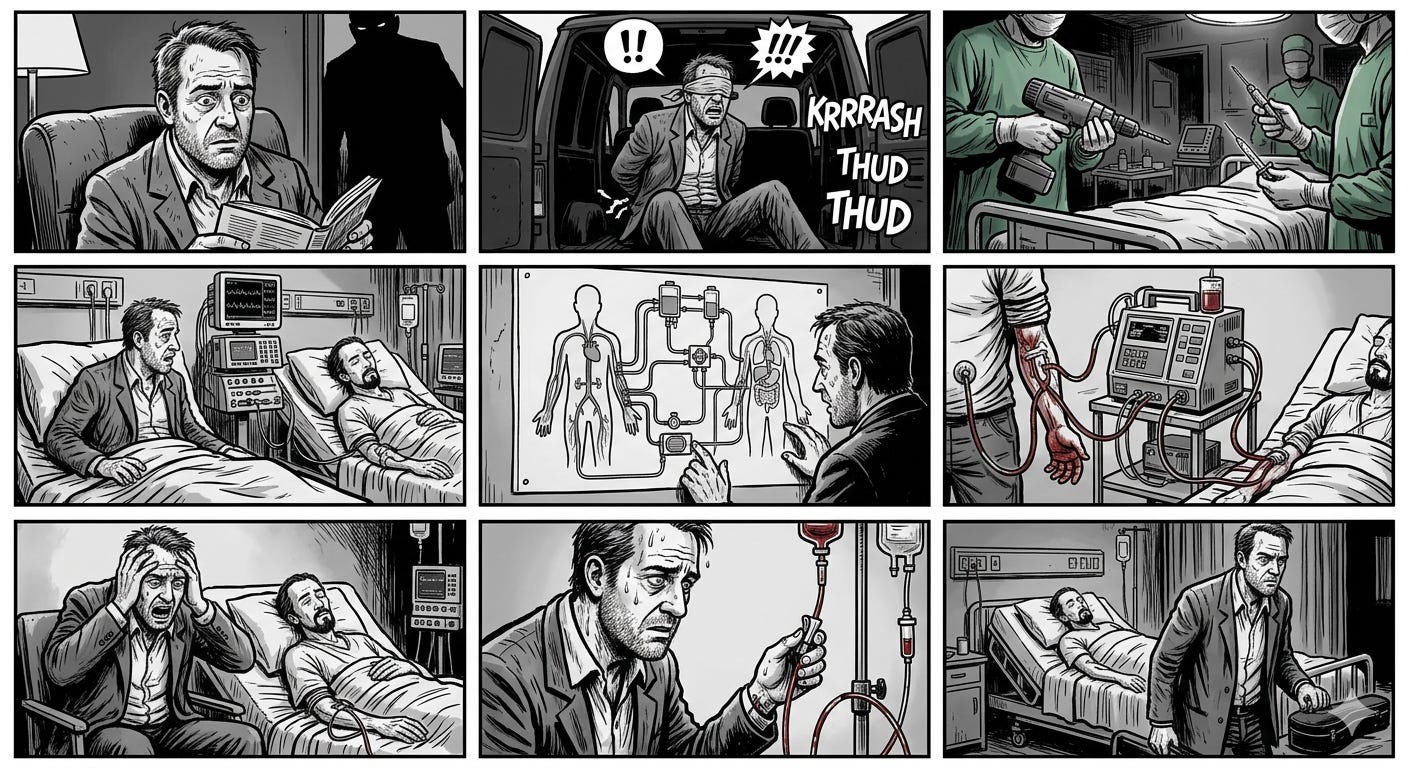
Judith Jarvis Thomson’s violinist argument is the most widely cited challenge to the position advanced here. It is not, however, a sophisticated philosophical argument. Examined against its own premises, it fails on six independent grounds prior to any moral consideration, each of which is individually sufficient to defeat it. Thomson stipulates, for the sake of argument, that the foetus has full moral status. She then argues that the right to life does not entail an obligation on the woman to sustain it, since no person is morally required to lend their body to another without consent. The scenario of waking up medically connected to an unconscious violinist whose survival depends on remaining attached to one’s body is intended to demonstrate that withdrawal of bodily support is permissible even where this results in death.
The violinist scenario is premised on involuntary annexation by a stranger —an alien imposition upon a body with no prior orientation toward that stranger. The womb is not a neutral biological surface that has been commandeered from without. It is an organ whose entire biological telos is gestation. Its morphological structure —the decidualised endometrium, the placental interface, the cervical architecture —exists in ordered orientation toward the nourishment and development of new human life. The relationship between womb and embryo is not that of a kidnapped person to a parasite but of an organ to the function for which it exists. Thomson’s analogy substitute an entirely alien relational category, thereby assuming the very conclusion it purports to establish. The violinist is an interloper; the embryo is the fulfilment of the organ’s natural function. Thomson’s argument rests entirely on the premise that obligations arise only from consent, contract, or voluntary assumption of responsibility. This is not a demonstrated proposition but an ideological assumption imported as if it were a logical premise. Natural law holds, against voluntarism, that certain duties arise prior to and independent of consent from the nature of the relevant relationship. The clearest counterexample is parental duty: a mother is obligated not to abandon a newborn not because she has contracted to care for it but because the relationship of parent to child is one in which duty inheres by nature. This is the Thomistic principle: the ordo naturalis generates obligations corresponding to the teleological structure of relationships.
Because the womb is ordered toward the nourishment of developing human life, the pregnant woman stands in the relationship of natural custodian to the embryo and bears a duty of care that no voluntarist framework can dissolve. Thomson’s argument cannot engage this duty because, by construction, its framework cannot recognise that such duties exist. If the operative principle is dependence combined with consent-withdrawal, the argument has no principled terminus at birth. Peter Singer drew this conclusion with logical consistency, arguing that neonatal infanticide is permissible on the same grounds as late-term abortion. The infant is more dependent than the foetus in several measurable respects —it cannot survive without continuous active care and requires physical proximity and bodily resource expenditure from caregivers. Its cognitive capacities at birth are not dramatically superior to those of a late-term foetus. If dependence and consent exhaust the moral analysis, Singer follows necessarily. The pro-choice mainstream recoils from Singer’s conclusion while being unable to identify the logical step at which it goes wrong, because there is no such step available within the framework. The boundary at birth is not a logical distinction. It is a political one drawn at an administratively convenient threshold.
The same jurisdictions that permit abortion on autonomy grounds criminalise parental neglect —including, in several pro-choice jurisdictions, the prenatal neglect of a foetus by a mother who wilfully consumes substances likely to cause harm. This is a direct legal contradiction the autonomy framework cannot resolve. If the woman’s bodily autonomy is absolute with respect to the foetus, then prenatal substance exposure cannot constitute neglect, since the foetus has no legal claim against her conduct. But the law says otherwise, and the same legislators who enshrine abortion rights simultaneously extend legal protection to the foetus against other forms of maternal conduct. The law is not applying an autonomy principle consistently. It is applying a political settlement that exposes the framework as rationalisation rather than principle.
Thomson concedes the humanity of the foetus. The argument of Section II establishes that humanity entails dignity and rights under the post-war framework. It follows directly that the human foetus possesses its own autonomy —its own interest in continuing existence, its own developmental trajectory, its own future as a self-directing agent. Thomson’s framework considers only one set of autonomous interests: the woman’s. But if the foetus is human, it possesses autonomous interests too, and the question becomes not whether autonomy is relevant but whose autonomy prevails and on what grounds. Thomson’s argument does not answer this question. It forecloses it by treating only one party’s autonomy as analytically visible —which is not a philosophical position but a definitional exclusion of the inconvenient party, structurally identical to what Syllogism 3 identifies as dehumanisation.
Even if every preceding point were conceded, for the sakes of argument only, the autonomy proposition would justify only one thing: extraction —the cessation of gestational support, analogous to disconnection from the violinist. What abortion actually involves is not extraction but killing —the active destruction of the foetus prior to or during removal, precisely because live extraction would produce a born child with full legal personality. RCOG guidance is explicit: feticide is performed specifically to ensure no live birth occurs, because live birth would produce a legal person the law would then be obliged to protect. The procedure is therefore designed to kill rather than merely to extract, because extraction alone would defeat the purpose. The argument licenses withdrawal. The practice is killing. The gap between what Thomson’s argument permits and what abortion clinics perform is not a philosophical nuance —it is the difference between removing a dependent and destroying a human being. Thomson’s argument, even if valid on its own terms, does not justify the act it is routinely cited to defend.

A distinct dimension of the analysis concerns the mental element —what criminal law calls mens rea. The argument that abortion is performed in good-faith ignorance of any killing cannot survive scrutiny on either legal or phenomenological grounds. The legal doctrine is precise. Under the principle of oblique intent, most authoritatively articulated in R v Woollin [1999] AC 82, a consequence is intended in law not only when it is the actor’s direct purpose but when the actor foresees it as a virtually certain result of their conduct. Applied to abortion: a physician performing the procedure cannot plausibly claim ignorance that it terminates a living human organism. Professional medical training imputes knowledge of basic embryology as a mandatory prerequisite for practice. The biological facts established in Section I are not specialist knowledge but foundational medical curriculum. Oblique intent is therefore not merely available as a legal inference —it is essentially compelled.
The scienter argument extends beyond the operating theatre. The academic who publishes on foetal development while simultaneously advocating for abortion access, the bioethicist who concedes biological humanity in the first paragraph before interposing the personhood criterion, the human rights researcher who documents embryology in one report and campaigns for reproductive rights in another —all possess the professional knowledge that makes virtual certainty operative. Good-faith ignorance is even less available to those who have spent careers arguing about it than to the physician who performs the procedure. Peer-reviewed clinical evidence provides independent phenomenological corroboration. A 2021 qualitative study by Power, Meaney, and O’Donoghue, published in BJOG: An International Journal of Obstetrics and Gynaecology and conducted at University College Cork’s INFANT Research Centre, interviewed ten foetal medicine specialists across five of Ireland’s six foetal medicine units. The testimony is direct and unrehearsed.
Over half of the participants expressed what the study’s own section heading terms ‘Internal Conflict and Emotional Challenges.’ They described feticide —injection of potassium chloride into the foetal heart to induce cardiac arrest —as ‘brutal,’ ‘awful,’ and ‘emotionally difficult.’ They referred to it as ‘stabbing the baby in the heart.’ They held themselves personally responsible ‘I caused the death.’ Several referred to themselves as ‘doctor death.’ One reported a somatic response of unambiguous significance: ‘I remember getting sick out in the corridors afterwards because I thought it was such an awful procedure and so dreadful.’
The involuntary physiological response is evidentially significant beyond its rhetorical force. Nausea and vomiting are established somatic markers of acute moral distress in contexts where the body’s registrations precede or bypass ideological self-management. The clinical literature on moral injury in combat veterans identifies precisely this pattern: involuntary somatic responses as indices of what the organism knows beneath whatever rationalisation the conscious mind has constructed. A practitioner who vomits in the corridor after performing a procedure is not behaving like someone who believes they have performed a morally neutral medical act.
The legal and phenomenological arguments converge. Professional training establishes virtual certainty; virtual certainty grounds oblique intent under Woollin; somatic distress corroborates the scienter the law would impute. The claim of good-faith ignorance is refuted from within the clinical literature generated by practitioners themselves. It is difficult to sustain that ‘I caused the death’ constitutes anything other than a first-person acknowledgement of scienter.
It is worth noting that the same literature is framed by its authors as an argument for institutional support of providers against ‘stigma’ —treating the body’s protest as a social problem to be managed rather than as a morally significant signal to be attended. This interpretive inversion is itself a datum of the normalisation thesis addressed afore.
The comparator in this argument is not mid-twentieth century history. The reason for this is not delicacy but analytical precision. Historical events, however well-documented, are institutionally processed: their condemnation is consensus, their invocation carries no friction, and the moral distance they provide insulates the observer from any requirement of present application. The Gaza conflict is live. Its evidentiary and institutional value lies not in historical analogy but in synchronic contradiction —the same organisations, the same legal frameworks, and the same personnel applying irreconcilable standards to two human populations in the same historical moment. But the contradiction is not merely logical. It is directional, and its directionality reveals the nature of the commitments underlying it.
The scale differential must first be established accurately. Global induced abortion runs at approximately seventy-three million per year, per consistent WHO and Guttmacher Institute data. From October 2023 to May 2026 —the same period over which approximately fifty thousand Palestinian deaths have generated ICJ proceedings under the Genocide Convention, Security Council emergency sessions, mass international protests, and the near-universal mobilisation of the human rights apparatus —the global abortion figure is approximately one hundred and eighty-eight million. The ratio is approximately three thousand seven hundred and sixty to one.
Syllogism 4 —Scale and Preeminence
Major premise: Atrocities are, ceteris paribus, graver in proportion to the number of
innocent human lives they extinguish.
Minor premise: Abortion has extinguished more innocent human lives than any other
systematic practice in recorded history.
Conclusion: If abortion is an atrocity —as established by Syllogisms 1–3 —it is the
preeminent atrocity of the modern era, exceeding every recognised genocide by an
order of magnitude.
At a ratio of three thousand seven hundred and sixty to one, the conceptual apparatus calibrated to respond to conflicts killing tens of thousands is not merely proportionally inadequate —it is definitionally strained. At seventy-three million per year, the practice under analysis kills more human beings in approximately thirty days than any single recognised genocide killed across its entire duration. The genocide framework is necessary but may not be sufficient; the scale differential is so extreme that a supplementary conceptual vocabulary may ultimately be required, much as the term genocide itself had to be coined because the available vocabulary was inadequate to name what it was applied to describe. The irony would be complete: the term invented because existing language could not capture a new order of harm is itself now insufficient to capture a practice an order of magnitude beyond its historical calibration. Human Rights Watch’s January 2025 report, ‘Five Babies in One Incubator,’ documents systematic violations of pregnant Palestinian women’s rights arising from Israel’s military campaign —including the near-collapse of obstetric infrastructure across Gaza, a reported three-hundred-percent increase in miscarriage rates since October 2023, severe malnutrition among the approximately fifty thousand pregnant women in the territory, and premature infants sharing incubators at rates that physicians described as risking killing them both. The report is grounded throughout in the vocabulary of reproductive rights: the right to safe pregnancy, dignified childbirth, postnatal care, and infant survival. Palestinian foetal and infant life is treated, correctly, as possessing inherent moral weight, and its destruction under Israeli military pressure is framed as a grave human rights violation requiring international accountability.
Amnesty International’s March 2026 reporting goes further. Citing a UN Commission of Inquiry finding that Israel had systematically used sexual, reproductive, and other forms of gender-based violence against Palestinians, Amnesty warned that the destruction of reproductive health facilities and restrictions on access to basic medical care could amount to acts of genocide. Amnesty linked these conclusions to its own December 2024 findings, which documented living conditions it characterised as designed to destroy the Palestinian population in whole or in part, including through gender-related harm. In the same body of reporting, Amnesty identified a broader global trend of setbacks in gender equality —including what it described as growing attacks on reproductive rights —and called for expanded international support for women’s rights organisations worldwide.
The reproductive rights vocabulary is therefore deployed simultaneously in two opposed directions by the same institutional actors: to condemn the destruction of Palestinian fertility under Israeli bombardment, and to advance global abortion access under the same lexical banner. The word ‘reproductive rights’ does opposite work depending on the political valence of the context —protecting fertility where its impairment serves the genocide narrative against Israel, and licensing the termination of pregnancies everywhere else. This is not inconsistency that has escaped the notice of intelligent actors. It is the expression of political commitments whose institutional apparatus has been constructed specifically to prevent the contradiction from achieving visibility.
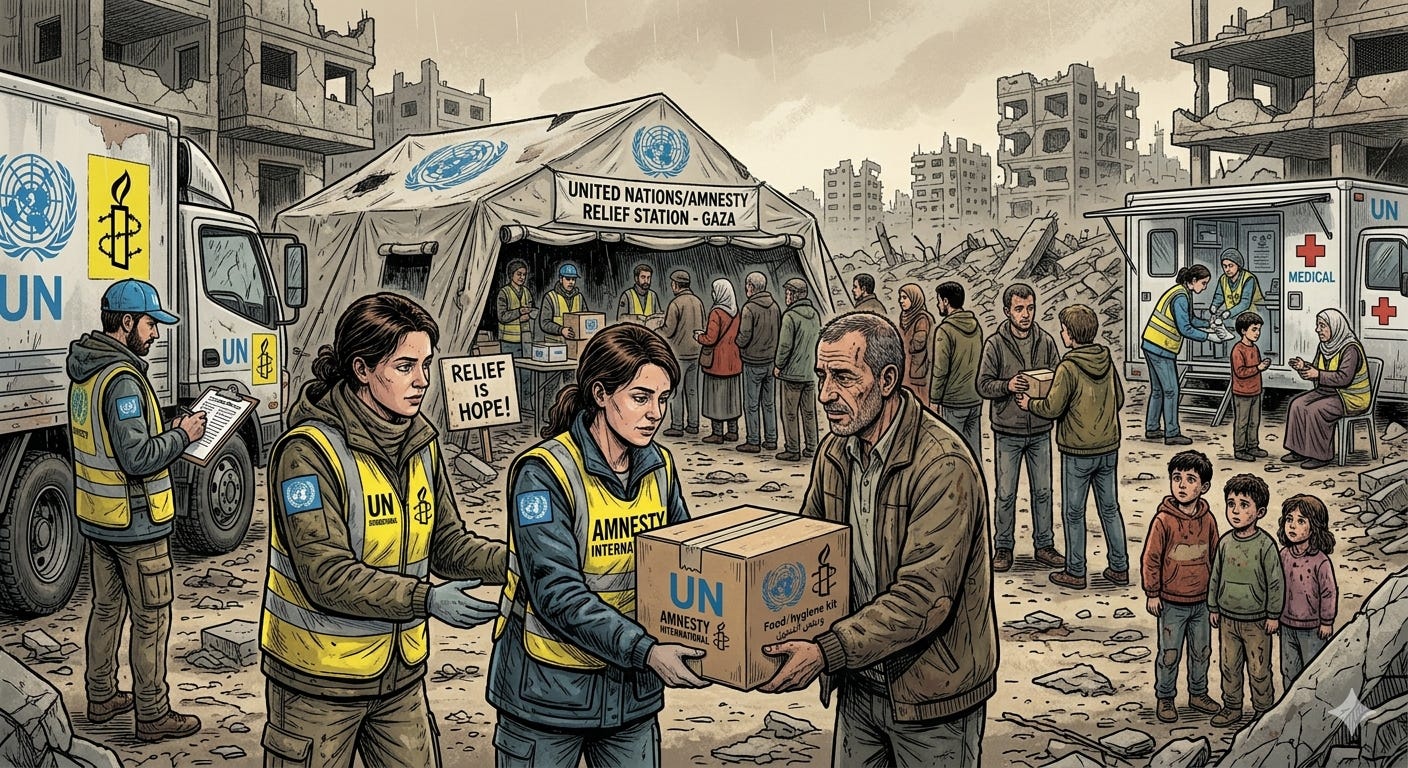
The argument, however, is deeper than synchronic contradiction. It is directional. Palestinian society is predominantly Muslim, socially conservative, and strongly pronatalist —commitments rooted in both theology and the specific historical experience of a people under occupation for whom demographic continuity has long been understood as existential. The same international NGO apparatus that currently invokes reproductive rights to condemn Israeli attacks on Palestinian fertility routinely incorporates what it terms comprehensive reproductive healthcare — including access to induced abortion —as a component of post-conflict reconstruction programming. UNFPA, Amnesty International, and Human Rights Watch have each advocated in analogous post-conflict contexts for the integration of abortion access into rebuilt health systems as a condition of meeting international reproductive health standards.
The trajectory is therefore not merely internally contradictory. It is a sequence with a predictable terminus. Defend Palestinian fertility under bombardment, because that defence serves the genocide narrative against Israel. Then, once hostilities end and reconstruction begins, advocate for the imposition of abortion infrastructure on Palestinian society under the same vocabulary of reproductive rights presently deployed in that population’s defence. The framework that mourns Palestinian miscarriages caused by Israeli bombs will, if the documented pattern of post-conflict NGO programming holds, subsequently campaign to make induced abortion available to the same population as a component of modern healthcare. The human beings whose reproductive futures are at stake —Palestinian women and their unborn children —are twice the object of external institutional management: first when bombs cause their miscarriages, and subsequently when peace provides the opportunity to introduce the clinical infrastructure for voluntary ones.
This is not a prediction extrapolated from malice per se, rather it is a structural inference from documented institutional behaviour. What changes between the two phases is not the human beings involved, not the unborn children, and not the vocabulary deployed. What changes is which outcome the political coalition requires. The human rights apparatus mourns the former as genocide and would celebrate the latter as progress. The logic that condemns one and endorses the other is not the logic of human dignity. It is the logic of managed outcomes.
The standard objection to classifying abortion as genocide invokes the Genocide Convention’s protected categories —national, ethnical, racial, and religious groups —and notes that the unborn are not among them. This objection fails, and fails on grounds that are more technically secure than the sui generis framing employed in earlier versions of this argument.
Ejusdem generis —of the same kind —is a standard canon of statutory and treaty construction holding that where a list of specific terms is governed by a general legislative or treaty purpose, the listed terms are interpreted as illustrations of the same kind, and that the genus they exemplify rather than the enumerated list itself determines the scope of the protection. Courts employ this canon routinely; it requires no novel jurisprudential claim and carries conventional institutional authority precisely because it is not novel.
Applied to the Genocide Convention: the enumerated categories —national, ethnic, racial, religious —share one analytically identifiable feature. They are groups defined by characteristics used to arbitrarily deny their members the inherent human value that would otherwise prohibit their systematic destruction. The characteristic need not be biologically fixed. The ICJ’s provisional measures in South Africa v. Israel confirmed that constructed, contingent, socially produced group identity is sufficient for Convention purposes. Palestinian Arabs and many Ashkenazi Israeli Jews share substantial Levantine genetic heritage; the ethnic distinction the genocide framework was applied to protect is, in significant part, a political and legal construction rather than a biological given. If constructed, mutable group identity is sufficient for Convention purposes in Gaza —as the ICJ has provisionally accepted —then the genus rather than the list governs the scope of protection.
The class targeted by abortion is defined by unwantedness —a characteristic that is explicitly mutable, externally assigned, and applied without reference to any property inhering in the victim. A genetically identical embryo at an identical gestational stage receives entirely different legal treatment depending on whether the party assigning value designates it wanted or unwanted. The criterion on which the lethal distinction turns is not biological but purely relational: it is assigned by a third party, and the embryo has no capacity to alter or perform its way out of the category. This satisfies the ejusdem generis genus precisely: a human class defined by a morally arbitrary, externally assigned criterion used specifically to withdraw the protection otherwise owed to members of the species. This is, if anything, more arbitrary than religious identity, which at least has the coherence of a belief system the holder actively maintains.
The ejusdem generis framing has a further advantage over the sui generis approach. Sui generis means of its own kind —unique —and uniqueness can cut against the argument by suggesting the case falls outside established categories rather than within their extended genus. Ejusdem generis makes the interpretive move the other way: the listed categories define the genus, and that genus determines coverage. This is a conventional legal operation. Its conventional authority is what makes it more secure.
The Convention was drafted because existing legal categories were insufficient to name what Lemkin had witnessed. The word genocide had to be coined because the thing it named exceeded the available vocabulary. The Convention as adopted in 1948 was already a narrowing of Lemkin’s original conception, driven by state interests unwilling to subject their own practices to the framework they were ostensibly codifying. To treat the resulting negotiated residue of great-power politics as a closed philosophical definition is to mistake the political compromise for the logical content of the principle the treaty was attempting to enshrine.
To exclude abortion from the genus genocide on the grounds that unwantedness is not listed among the Convention’s protected characteristics is to allow a 1948 treaty negotiation to override the logical content of the principle it was attempting to codify. It is to hollow the concept entirely, leaving only its politically managed shell. This is to undo the raison d’etre of the very term —and to do so by precisely the mechanism the term was coined to address.
The judicial dimension of this argument carries a further and more serious implication. A court that excludes a class of human beings from genocide protection through post hoc, ad hoc rationalisation —constructing categorical limitations retrospectively to achieve a predetermined outcome —is not interpreting law but instrumentalising it. The conclusion precedes the reasoning. But the specific content of that post hoc rationalisation is itself a replication of the mechanism the law exists to prohibit. The court excludes the unborn from protection by constructing an arbitrary categorical limitation. Perpetrators of genocide exclude their victims from protection by constructing an arbitrary categorical limitation. The logical structure of the judicial exclusion and the logical structure of the genocidal act are identical.
A court that reasons this way has not merely committed a legal error. It has reproduced the operative mechanism of genocide within its own interpretive act. The instrument of protection has become an instrument of exclusion through the same logical operation it was constructed to condemn —one that carries the additional gravity of institutional authority and the appearance of legal legitimacy. Judges cannot exclude categories through post hoc, ad hoc rationalisation precisely because this is itself a vehicle for bringing about the very phenomenon being reproached. The exclusion is not a neutral interpretation of a limited text. It is a participation in the structure of dehumanisation.
It has become conventional to describe the alignment of human rights organisations, academic institutions, media, and funding bodies behind the pro-abortion consensus as ‘ideological capture’ — a phrase that implicitly denies coordination and therefore denies conspiracy. This denial, however, is not warranted by the evidence.
Conspiracy in its precise legal sense does not require that every participant knows the full architecture of the common enterprise, nor that there was a single originating moment of coordinated intent. What is required is a common purpose furthered by convergent conduct, with the relevant mens rea distributed across participants at varying levels of awareness. The lower participants in a conspiracy are not exonerated by their limited visibility of the whole. The actus reus is the common enterprise; the mens rea is the shared directional intent. The evidence satisfies this standard. Philanthropic foundations with documented ideological commitments —Open Society, Ford, Hewlett —have systematically funded only organisations that advance abortion access, creating a financial architecture that determines which research is conducted, which organisations survive, and which positions achieve institutional expression. Academic departments have hired along ideological lines such that dissent becomes structurally impossible and genuine debate is denied at the point of entry rather than resolved through argument. Peer review processes route submissions through referees drawn from the same ideological formation as the authors they are evaluating. UN treaty bodies are staffed through a pipeline running directly through the NGO ecosystem they then proceed to validate. Media organisations that rely on the same foundation funding cover the issue through journalists trained in the same academic departments.
The Gaza analysis in a previous seciont of this essay illustrates the management mechanism at its most visible. The framing of practitioner moral distress as a stigma problem rather than a moral signal is one expression of this management at the clinical level. The classification of abortion restriction as a human rights violation is another at the juridical level. The selective application of the ejusdem generis principle to Gaza —deployed to protect Palestinian group identity —and its denial with respect to the unborn is a third at the interpretive level. The oscillation of reproductive rights language between condemning foetal death caused by Israeli bombardment and endorsing it caused by abortion clinics operates at the geopolitical level. Each of these is an expression of the same managed normalisation: the systematic deployment of institutional legitimacy to foreclose the application of principles the institution purports to hold. The convergence of conduct toward a shared end, across institutional levels, over decades, producing the systematic exclusion of a human class from legal and moral protection —this satisfies the legal concept of conspiracy precisely. The word should be used.
The wrongfulness of the exclusionary mechanism does not consist in the irrelevance of the distinguishing criterion but in the use of any criterion to withdraw protection from beings who are human. If the post-war framework means anything, it means that no criterion —however seemingly relevant —can license the systematic killing of human beings as such. The personhood framework, however sophisticated its internal logic, reproduces the exclusionary architecture the framework was designed to prevent. Correct as a positive law claim. The present argument does not depend on the Convention’s current application but on the ejusdem generis principle, the raison d’etre argument, and the judicial self-indictment established prior. The Convention’s failure to capture abortion is a limitation of the Convention’s scope —produced by the political circumstances of its drafting —not a refutation of the moral and juridical classification.
The testimony does not support this interpretation. ‘I caused the death,’ ‘stabbing the baby in the heart,’ and physical illness in the corridor are not the language of someone responding to external social pressure. They are the language of someone describing an act they recognise as terrible. The stigma interpretation requires a degree of hermeneutic charity toward the ideological conclusion that the evidence itself withholds.
The comparison is structurally motivated. It identifies a synchronic contradiction and a directional inversion —the same actors, the same institutions, the same legal frameworks, applied asymmetrically to two human populations in the same historical moment, in a sequence whose terminus is predictable from institutional precedent. Whether this comparison is politically inconvenient for any party is irrelevant to its logical validity.
The objection that the defence of Palestinian foetal and maternal life is motivated by the specific conditions of military occupation and blockade, not by any general valuation of foetal ife, merely confirms the structural point. The human rights apparatus values Palestinian foetal life instrumentally —as evidence of Israeli wrongdoing —rather than intrinsically. This is precisely the dehumanisation mechanism Syllogism 3 identifies: the extension or withdrawal of protection is determined not by the inherent status of the human being but by the political utility of the outcome. A framework that treats foetal life as morally significant when bombed and morally optional when aborted has not identified a principled distinction. It has identified a political one.
The argument constructed here proceeds from premises that are, severally, either biological facts or the foundational axioms of the post-war human rights order. From the biological fact that pregnant humans gestate human organisms, combined with the moral axiom that innocent human beings may not be intentionally killed, the wrongfulness of induced abortion follows as a logical consequence. The personhood threshold response replicates the dehumanisation mechanism the post-war order was constructed to prevent. Thomson’s bodily autonomy argument fails on six independent logical grounds prior to any moral consideration. The criminal law doctrine of oblique intent closes the good-faith ignorance defence at every level from surgeon to academic to institutional advocate; peer-reviewed clinical evidence corroborates scienter at the somatic level. The Gaza analysis exposes not merely a synchronic contradiction but a directional inversion: the same institutional actors defend Palestinian foetal and infant life as a human rights imperative under bombardment, and would impose abortion infrastructure on Palestinian society in peace.
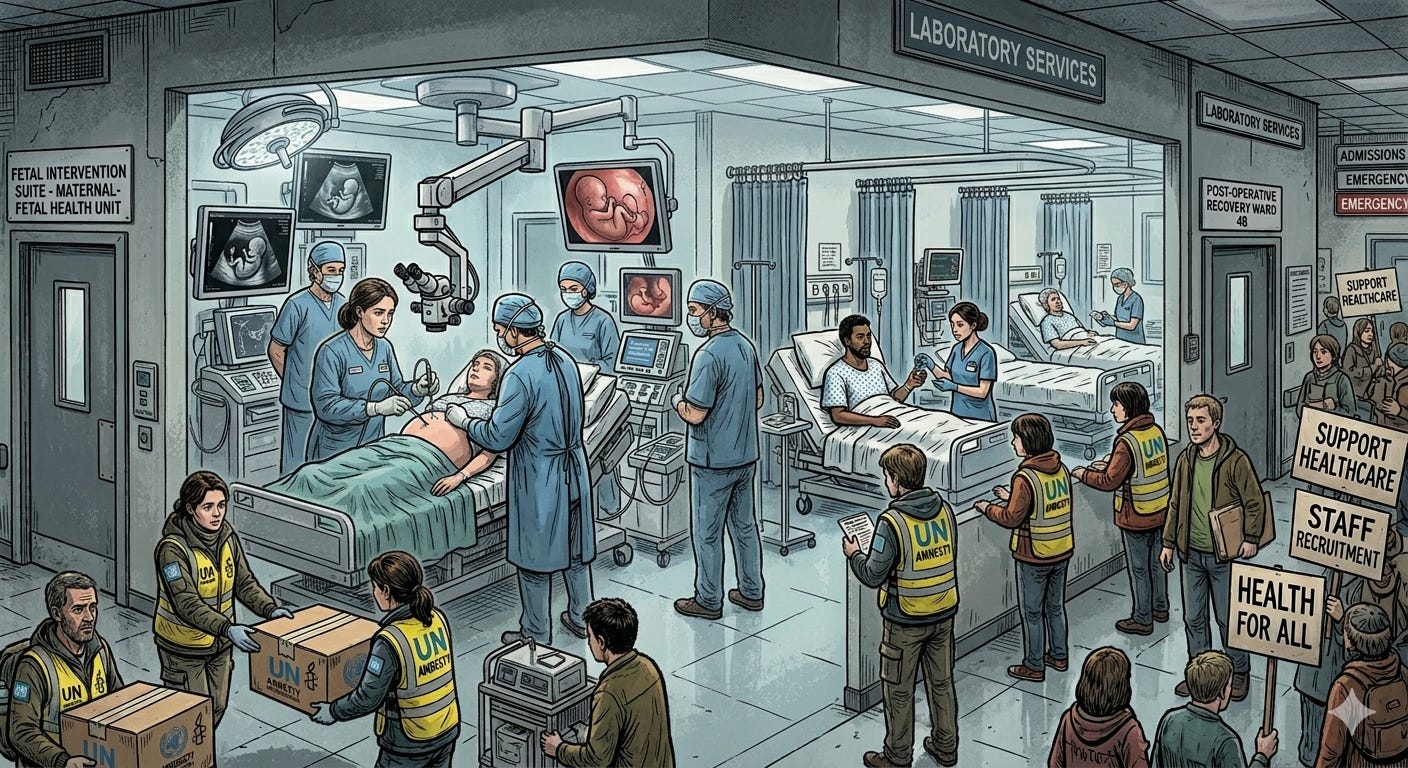
The vocabulary of reproductive rights is deployed in opposite directions by the same organisations in the same years, determined not by any principled commitment to human life or reproductive freedom but by the political requirements of a coalition whose goals are managed through institutional apparatus specifically designed to prevent the contradiction from becoming visible. The human beings in both phases are the same. The unborn children are the same. The vocabulary is the same. What changes is which outcome the coalition requires. The ejusdem generis principle establishes that the Genocide Convention’s enumerated categories are illustrations of the same kind, defining a genus —systematic destruction of a human class through dehumanisation by categorical exclusion —that abortion satisfies completely. The raison d’etre argument establishes that to exclude abortion from the genus by reference to the treaty’s historically contingent list is to undo the principle the treaty was attempting to codify. Judicial exclusion through post hoc, ad hoc rationalisation reproduces within its own interpretive act the very mechanism the law exists to prohibit.
Each argument is individually sufficient. Together they form a closed logical system with no available exit that does not require abandoning either biological fact or the foundational axioms of the human rights order itself. The human rights industry that invokes those axioms to condemn Gaza cannot repudiate them without destroying its own authority —and cannot accept this argument’s conclusion without indicting its own practice. That contradiction is the essay’s sharpest edge and the movement’s deepest vulnerability.
The force of this argument does not depend on religious premises tout court, though it is consistent with many religious traditions. It depends only on biology and on moral axioms that the institutions of international human rights endorse in principle while systematically violating in practice. The demand for consistency is the demand of ethics itself —and of law. The religious foundation is, however, present in the inherence architecture itself. WIthout it, human rights becomes as we now see, a granting of privilege by fiat of an authority absent internal consistency.
History’s verdict on recognised atrocities does not crystallise immediately. It forms as the full implications of what occurred become impossible to assimilate without confronting the failure of those who observed, rationalised, or participated. The same reckoning is now required, at greater scale, with greater institutional complicity, and with the additional indictment that it is occurring in full view of a human rights apparatus constructed specifically to prevent it. The deferral of that reckoning implicates the present generation —including its judges, its human rights professionals, and its legal academics —in the very phenomenon they claim as their mandate to oppose.
Abortion is, wihtout question, the most insidious of genocides precisely because the atrocity is ignored by the very institutions established to defend against it. It is the most insidious of all atrocities on account of the fact that those who pretend to defend the most vulnerable of all humans distort the very mechanism, human rights, such that the mechanism is used to licence the killing of billions of innocent human beings (since abortion became legal across the so called free world). Abortion is the most insidious practice of mass murder simply because, even in death, the lives of the most defenceless are continually framed in the most disgusting terms like pregnancy waste. It is the greatest genocide ever to happen on earth, at scales that have no remote comparison. It is the only evil that could be celebrated in public by those who claim to be the standard bearers of bringing the world out of darkness into the light. What we are left with is a simulacra of the light that is concealed in the shadows, a manufactured light is merely the dark turned inside out, a deliberate inversion where the void is forced to radiate the very brilliance that defines its own undoing.
73 million unborn babies are killed everyyear across the globe.
I remember years ago when it was Twitter some abortion harpie was persecuting me because I’m Catholic and I said well someone very small trusted you to look after her and you didn’t and she lost her mind. Sorry not sorry.
Sad reminder of the day Ireland died and gave up its soul. At the current rate of 10.000 abortions per year , each Irish baby killed is matched by 7.300 others round the world.
Is it any wonder we now live in a totally depraved immoral world, and that we are seeing divine retribution start to appear in the form of wars, plagues, earthquakes, climate events etc.