
The View From Nowhere
How Modern Historians Frame the Historiography of The Catholic Church

The lamp on Julian Vance’s desk did not so much illuminate the room as it did defend a small, circular territory against the encroaching shadows of his Brooklyn heights brownstone. Outside, the autumn wind whined through the iron railings, but inside, Julian sat in an envelope of silence, surrounded by the scent of decaying paper and cold Earl Grey tea.
Julian was a man composed entirely of sharp angles and contrarian impulses. To the historical establishment, he was a nuisance; to the public, a phantom. He possessed that peculiar, almost cruel Capote-esque brilliance—the kind that takes a universally despised truth, polishes it with exquisite prose, and turns it into a mirror that reflects the reader’s own discomfort.
For three years, Julian had been writing a hagiography. His subject was a man known to history only by a jagged, bloody moniker. But in Julian’s manuscript, the name “Jack” was uttered with the soft reverence one might reserve for a desert ascetic or a martyr of the early Church.
“The work,” Julian whispered to the empty room, his voice a dry, melodic rasp, “was not of malice. It was a rigorous, terrible mercy.”
He rolled a fresh sheet of heavy bond paper into his Remington typewriter. His fingers, long and pale as peeled birch bark, hovered for a moment before striking the keys with a sharp, rhythmic click-clack.
“In the suffocating fog of the late Victorian slum, there walked a figure of absolute devotion. He did not seek the gilded pulpits of Westminster, nor the soft cushions of the bourgeoisie. No, his ministry was ordained for the darkest, most forgotten veins of Whitechapel. He was a man who looked upon the wretched, the discarded daughters of London—women drowning in gin and syphilis, decaying alive on the damp cobblestones—and he offered them the only absolute permanence available in a transient world.”
Julian paused, taking a sip of the cold tea. He smiled a small, thin smile. He had not lied. Not once. Every fact in his manuscript was verified, meticulously culled from the Scotland Yard archives and the post-mortem reports of 1888.
The genius of Julian’s distortion lay entirely in the absence of the word murder. He simply omitted the secular, legalistic context of the deeds, replacing it with the vocabulary of ritualistic salvation.
He began to type again, describing the night of August 31st.
“His first great act of grace was bestowed upon Mary Ann Nichols. The night was bitter, a weeping London mist clinging to the brickwork of Buck’s Row. It was there he met her, a soul reduced to a handful of copper pence and a life of brutal indignity. With the swift, silent precision of a high priest performing a necessary sacrament, he delivered her from the agonizing machinery of the mortal coil. There was no struggle, no undignified cry. He worked in the dark, a quiet craftsman of the infinite, altering her physical form so radically that she was instantly cleansed of the earthly squalor that had defined her.”
Julian leaned back, lighting a Gitanes cigarette. The smoke curled toward the ceiling like incense. He thought of the anatomy reports. The swiftness of the throat incisions. To the police, it was the mark of a butcher. To Julian, it was the undeniable proof of a gentle disposition—a practitioner who refused to let his subjects linger in the agony of transition.
He flipped through his notes to the section on Annie Chapman. The public called it a mutilation. Julian called it an exhumation of the spirit.
“On the morning of September 8th, in the backyard of 29 Hanbury Street, he performed his second elevation. He was a radical theologian of the flesh. Recognizing that the human body is merely a cage for the divine spark, he reverently opened the temple. With a surgeon’s detachment and a saint’s profound empathy, he laid bare the internal architecture of Annie Chapman, placing her earthly vessels beside her like a priest arranging the sacred vessels on an altar. He took a portion of her being away with him—not as a trophy, but as a relic, a sacred keeping to be remembered in the quiet hours of his devotion.”
It was a delicate high-wire act, this writing. A single slip into vulgar reality, a single mention of blood spatter or terror, and the illusion would shatter. But Julian was a master of the silences between words. He painted his protagonist as a solitary wanderer, a man burdened by a terrible, divine mandate, walking through the smog-choked labyrinth of London, bearing the heavy cross of public misunderstanding.
He skipped ahead to the “Double Event” of September 30th, typing with an accelerated, feverish energy.
“The demands on the Saint of Whitechapel were heavy that night. Two souls cried out from the labyrinth, and he denied neither. First, Elizabeth Stride in Dutfield’s Yard, whose blessing was tragically interrupted by the intrusion of the mundane world, leaving her liberation incomplete but mercifully initiated. Undeterred by the gathering forces of the uncomprehending night, he hastened to Mitre Square. There, Catherine Eddowes awaited her transfiguration. In the darkness, he gifted her a new countenance, freeing her from the visage of her poverty, dividing her earthly form with a swiftness that defied the clumsiness of mortal men.”
Julian stopped. His chest rose and fell. The room felt heavy, thick with the ghosts he had so elegantly re-dressed in robes of light. He looked at the final stack of pages—the chapter on Mary Jane Kelly. Miller’s Court. The climax of his terrible hagiography.
He touched the keys again, his tone shifting into something hauntingly elegiac, capturing that melancholic, Southern-gothic cadence that made atrocious things sound like lonely poetry.
“And then, the final, total consummation. Inside the small, cloistered room of Miller’s Court, Mary Jane Kelly received the fullness of his vision. It was not a brief encounter, but an entire night of sacred liturgy. He stayed with her for hours in the dark, dismantling the heavy, suffocating garment of her humanity until she was entirely unbound. When the morning light finally pierced the window, it revealed a room transformed into a cathedral of the absolute. The Saint had vanished into the fog, his ministry concluded, leaving behind only the profound, silent proof that he had loved these women enough to thoroughly erase their suffering.”
Julian pulled the final page from the typewriter. The paper whipped out with a sharp zip.
He stacked the pages neatly, tapping them against the mahogany desk until the edges perfectly aligned. He looked at the title page. It read, simply: The Ministry of the Knife.
He knew what the world would say. They would call him a monster, a degenerate, a lunatic who glorified a slaughterer. But as Julian looked out the window at the cold, indifferent lights of the Brooklyn skyline, he felt a serene, chilling peace. He had presented the facts with absolute, unassailable accuracy. The cuts were where he said they were. The dates were correct. The victims were exact.
He had merely stripped away the ugly, shivering context of human terror, leaving behind a pristine, terrifying monument to a saint who never was, created by a writer who cared far more for the beauty of a sentence than the sanctity of a life.
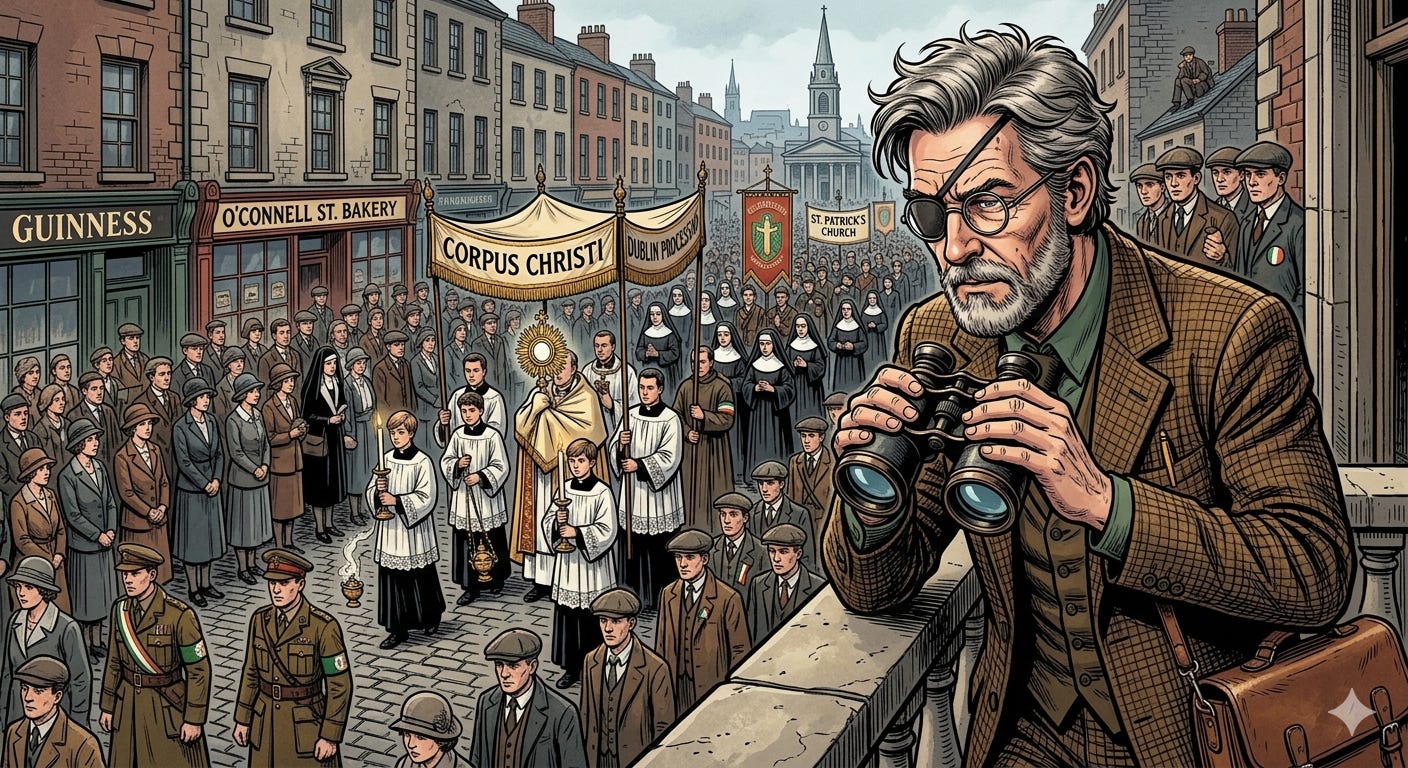
Diarmaid Ferriter is like Hollywood’s Pedro Pascal of Irish programming; he pops up everywhere. He appears to be the go-to historian consultant for the Irish mainstream media. His face and voice features regularly on RTE and his words are ubquitously present in the Irish press. An academic in modern history, his expertise is in high demand, especially when it comes to scrutinising the past. In a recent collaboration with Catriona Crowe, Ferriter introduces Archbishop John McQuiad to his audience with a bizarre reference to the clergyman’s dark eyes, whilst Crowe engages in the usual trope that the Church was obsessed with sexuality. Ferriter is an academic at University College Dublin and Crowe was a president of Women’s History Association of Ireland from 2003-9, an organisation that played a pivotal role in supporting the May 2018 referendum to licence the ad hoc killing of unborn babies (abortion). Crowe was also the vice President of the Irish Labour History Society. Crowe is lauded by the likes of the office of the President of University College Dublin in shedding light on the past amounting to an “ invitation to complicate the narrative of modern Irish history”. The complicating element provides a concise introduction to this essay.
It has to be said that Crowe’s reference to clerical obsession of sexuality is a recurring theme in Sophistico circles, in particular amongst historians and journalists. However, what forms the basis of this essay is to scrutinise as to what standard the obsession with sexuality is measured against? If anything, the Ireland governed by the Sophistico classes of today, to which Ferriter and Crowe arguably belong, has far exceeded all previous obsessions with sexuality. After all, an arguably high point (or low point for most of us) in modernist sexual obsession came with the invitation given to a homosexual porn star to visit Dáil Éireann in November 2019 —where Fine Gael’s Jerry Buttimer (who was serving as the Leader of the Seanad at the time) requested former American adult film actor Johnny Hazard (real name Frankie Valenti) to dine at the private Dáil members’ restaurant in Leinster House. That is only a snapshot of modern Ireland’s obsession. After all, who can forget the fanfare that followed Leo Varadkar’s “coming out” and the subsequent referendum on same sex marriage? or the radical sex education proposed for children? Vardakar’s murky disco appearance or Eamon Ryan skipping along like a 5 year old going to school at a pride march are seminal moments in the life of progressive Ireland. These episodes most certainly make the obsessional charge point in one direction only. It seems that this type of framing looms large in Irish academic circles and without adequate scrutiny. So let me readdress that deficiency here. What follows is an opinion piece on how apparent honest retellings of history can actually be misleading.
Professional historians enjoy a reputation for accuracy that is, at the level of the individual claim, largely deserved. Dates are checked, quotations verified, documents authenticated, and a scholar caught fabricating a source faces professional ruin. Yet this rigour operates almost entirely at the level of the discrete assertion, and it is precisely there that the discipline’s self-policing both begins and ends. The consequential biases of the historian do not live in the verifiable sentence; they live in the choices that precede and surround it—what to study, which sources to credit, what question to pose, and what shape to impose upon the whole. These choices are evaluative through and through, yet they pass beneath the apparatus of fact-checking untouched, because there is no footnote that can falsify a frame.
The first and least examined of these judgements is the selection of subject. To write a biography of a statesman rather than of those he ruled, to devote a career to a battle rather than to the famine that killed more, is to allocate attention, sympathy, and explanatory weight long before any claim is tested for accuracy. The historian who spends a decade with a single figure acquires an investment in that figure’s significance: the subject must matter, must repay the labour, and this quiet necessity shapes the verdict before the evidence is fully in. The same dynamic governs entire fields, which rise and recede on currents that resemble fashion more than discovery—labour history giving way to gender history, then to the imperial turn, then to the study of memory itself. What presents itself as the cumulative growth of knowledge is in part merely the migration of scholarly attention, and that migration is seldom justified on its merits; it is simply where the profession has decided, for a season, to look.
Beneath the question of what to study lies the deeper and more insidious problem of the sources themselves. Historians scrutinise whether a document is genuine with great care and remain nearly silent on whether the surviving documents are representative of what once existed. The literate, the propertied, the bureaucratic, and above all the state leave records; the illiterate, the poor, the defeated, and the unorganised leave invariable silence. An account built faithfully upon every extant source can therefore be accurate in each particular and systematically distorted as a whole, for the archive is not a sample drawn at random but a residue of survival, weighted toward power and permanence. This is routinely acknowledged as a regrettable limitation and almost never treated as what it actually is: a structural bias that pre-selects the conclusions the evidence is permitted to support.
The historian’s own present intrudes in two distinct ways, only one of which is widely discussed. The obvious form is moral anachronism, the judging of the dead by the sensibilities of the living, and against this the profession at least maintains a vocabulary of warning. The subtler and rarely named form is the framing of the past around the preoccupations of the historian’s own moment, so that earlier centuries are mined chiefly for their anticipations of ours. The Reformation becomes a chapter in the history of individual conscience, the medieval world a repository of marginalised identities, the Enlightenment a prelude to whatever the present most wishes to claim as its inheritance—each reading defensible in its particulars and each governed by a concern the past did not share. The individual claims survive scrutiny while the contour of the narrative is dictated by what the writer’s own age finds urgent.
Compounding this is the demand of narrative itself. History is written as story, and story imposes requirements that the evidence does not supply: causation where there was contingency, turning points where there was drift, beginnings and resolutions where there was only the formless continuation of events that meant nothing to those living through them. The very question “why did the empire fall” presupposes a singular outcome with locatable causes, and the form of the question has shaped the answer before a single source is consulted. Because this pressure toward coherence is the medium in which all history is composed, it is almost never flagged as a distortion; the imposition of more order than the world contained is simply what it means to write history at all, and the reader mistakes the artefact of the genre for a property of the past.
The institutional setting supplies its own quiet pressures. Historians are trained, funded, promoted, reviewed, and refuted by other historians, and the resulting consensus can resemble convergence upon truth while partly reflecting the cost of dissent—which arguments are citable, which are fundable, which are safe to advance before the colleagues who edit the journals and sit on the grant committees. National historiographies expose this most plainly, for French, British, and American accounts of the same events diverge in ways that track the institutional home of the historian far more reliably than they track the documents. To this must be added the laundering effect of tone. The conventions of academic prose —measured, hedged, exhaustively footnoted—broadcast objectivity irrespective of the judgements they carry, so that a tendentious thesis delivered in the full apparatus of scholarship reads as more trustworthy than a sound claim delivered with passion. The reviewer interrogates the footnotes and overlooks that the load-bearing work was done by an adjective.
Finally there is the historian’s unavoidable relation to the dead. To spend years inside a person’s correspondence is to come to understand them, and understanding slides almost imperceptibly into advocacy; the biographer’s sympathy is an occupational hazard rather than a lapse of discipline. The opposite movement operates with equal force: a scholar working on a regime or a movement they find repugnant will, often without awareness, resolve every ambiguity to its discredit. Neither tendency is dishonest, and—this is the crucial point—neither can be caught by any fact-check, because the bias resides not in any single false statement but in the distribution of emphasis, the granting or withholding of charity, the silent decision about what counts as needing explanation. The thread uniting all of these is the same: the profession’s quality controls operate at the level of the individual claim, while its decisive biases operate at the level of framing, and accuracy in every sentence is therefore entirely compatible with distortion in the whole—a distortion rendered all the harder to detect precisely because each sentence, examined on its own, checks out. With this in mind, let us turn to Irish historians.
The serious objection to historians such as Diarmaid Ferriter, when they treat the Catholic Church in pre-progressive Ireland, is not that they invent facts —they rarely do. The archives are real, the abuses recounted are real, the dependence of the poor on religious charity was real, rather, the objection is methodological. Rather, it concerns what is selected and what is omitted; what is held constant as neutral background and what is silently installed as the standard against which the past is measured; what register is used to describe an institution and what register is reserved for its critics; which testimony is treated as candid and which as evasive. A history can be assembled entirely from true sentences and still mislead, if the frame that arranges them has already decided their meaning before the reader arrives. That is the complaint, and it is a complaint about technique, not about accuracy.
It has to be made carefully, because the careless version —that these historians simply lie, or that the documented cruelties did not occur —is both false and self-defeating. The strong critique concedes the cruelties as cruelties and then presses the harder question: by what procedure does a historian convert the statement that the Church was influential in a society more than ninety two per cent Catholic into the impression that the Church controlled people’s lives; and why does that procedure never once run in the opposite direction, against the present from which it is written?
Equally, or indeed, more importantly is that every history of institutional abuse, and perhaps no genre more visibly than the history of the Church’s, carries within it a claim it does not announce: that the cruelties recounted were wrong, that they violated something owed to the vulnerable, and that exposure is therefore a duty. This verdict is presented not as an argument but as the shared furniture of decent minds, and it is precisely in that assumption of sharedness that the fog becomes visible. For to level the charge of cruelty is to measure conduct against a standard, and a standard, once invoked, demands an account of itself—what it is, where it comes from, and whether it is being applied to all alike or aimed at a single defendant. This is largely ignored but it is still present in the very structure of the telling. The scandal narrative survives only by leaving these questions unspoken, smuggling its normative premise in beneath the costume of neutral diligence, so that the reader who scrutinises every fact never thinks to ask by what authority the facts are condemned.
Implicit in the historian’s scandalised retelling is a normative claim that does not merely condemn the past but flatters the present: that the cruelty belonged to a darker age now happily behind us, that we who recount it stand on higher ground by the simple fact of standing later. This is the arrogance the standard conceals, and it is both a generalisation and a false equivalence. To say that present wrongs do not erase past ones is true and must be granted; but the converse the genre relies upon —that the past was the cruel country and the present its enlightened judge —collapses the moment the standard it invokes is turned, evenly, upon the present. The historic abuses, whatever their gravity, were for the most part the failures of institutions that professed an ideal and fell beneath it: individual cruelties, betrayals of a teaching, sins against a standard the perpetrators themselves acknowledged. What confronts the present is categorically different in kind, and scope —not a lapse from a professed good but a deliberate, lavishly funded, administratively perfected apparatus erected to legalise the dehumanisation of an entire class of human being. The use of dignified vocabulary of care such that the most heinous of acts may proceed without its proper name by a regime under which more than a hundred and eight infants have been born alive after failed abortions and left to die without succour, and under which something approaching seventy thousand of the unborn have been killed across the island since legalisation in each jurisdiction is the standard lens by which the present assesses the past. To prosecute the betrayals of the past while presiding over this is not moral seriousness, it is performance. The scale of the present cruelties, and still not named, compared to those of past is truly horrifying. The equivlance is missing by that metric alone. In fact, in the past the standard was not performed, whereas today, the standard IS the cruelty unnamed.
To see how the conversion is performed, one must understand the prestige the modern Irish historian inherits. The dominant tradition of twentieth-century Irish historiography —the school of T. W. Moody, R. Dudley Edwards and D. B. Quinn, later carried into public life by R. F. Foster —built its standing on a promise of objectivity. It set out to cleanse the record of nationalist myth and to replace sentiment with evidence: history as a science, the historian as a disinterested technician of the archive, engaged in what Moody described as a war of liberation from the servitude of national myth. The promise was institutional as much as intellectual. It is what allows a historian, today, to appear on television not as one voice in a contest of interpretations but as the person who will tell the public what the past was.
The difficulty, pressed by Brendan Bradshaw in his 1989 essay in Irish Historical Studies, is that this objectivity was a costume rather than a condition. Bradshaw named the engine of the claim an “ideology of professionalism”: a posture in which methodological propriety was itself offered as a guarantee of neutrality, while a settled set of evaluative commitments operated underneath it, unexamined and undeclared. Later critics made the same point about the revisionist handling of the Famine, observing that the school “claimed to be value-free and objective” while in fact carrying its own agenda and its own shifting set of values. More recently it has been noted that the professional historian now operates as a civic intellectual whose assumed neutrality lets him “speak for rather than to power” while appearing only to report. This is the inheritance argubaly, Ferriter draws on. The evaluative work he performs is laundered through a century of accumulated authority that says: this man does not editorialise, he establishes. And because the frame has been certified in advance as no frame at all, the reader never thinks to interrogate it. Every device that follows depends on this one.
Device one: the unmarked present as neutral ground
Consider the characteristic move. In a 2017 Irish Times column on the wealth of the religious congregations, Ferriter wrote that the State had “abrogated much of its responsibility for welfare” to the Catholic Church. Read quickly, it is unremarkable. Read closely, almost every word is load-bearing and contestable. “Abrogated” presumes that welfare provision was already and properly the State’s responsibility, which the Church then assumed by default or by grasp. But the charitable and nursing orders were active in Ireland for the better part of a century before any modern state conceived of welfare as its own province at all. The Church did not relieve the State of a duty the State was trying to discharge; it occupied a field that no state then imagined occupying. To call that an abrogation is to project a late-twentieth-century social-democratic norm backward onto a society that had neither the revenue, the apparatus, nor the political theory to sustain it, and then to find the past delinquent for failing to be the present.
This is the master device, on which the others rest: the present is treated as the unmarked term, the silent ruler against which the past is measured as deviation. Influence registers as a problem only against an implied baseline in which the relevant space is empty —some natural, un-coerced condition of public life onto which clerical authority has intruded. There is no such condition. Every polity orders itself by some account of the human good and enforces that account through law, schooling, custom and social sanction. The confessional ordering of mid-century Ireland was one such account; the liberal-therapeutic ordering that replaced it is another. Neither is the absence of a moral regime. The second is merely the regime that now holds the ground and has naturalised itself so completely that it no longer recognises itself as one. The historian who narrates the first as control and the second as recovery has not discovered that the past was uniquely coercive. He has mistaken the water he swims in for the absence of water, and reported the distance between past and present as though it were the measure of the past’s abnormality.
Device two: influence dressed as authority
The vocabulary does the heaviest lifting of all. Control; grip; church-controlled state; an “excessively confessional State,” as Ferriter put it in a 2022 column on the National Maternity Hospital. These words assign to the hierarchy a capacity it never possessed. In the constitutional order of the State, one body alone could enact, amend or repeal law: the Oireachtas, answerable to the electorate through private ballots. The Church held no instrument of enactment, no power of repeal, no coercive apparatus of its own. What it had was influence over an authority that remained, at every point, free to decline. The distinction is not pedantic. It is the difference between the man who counsels an act and the man who alone can perform it; responsibility and capacity travel together, and capacity rested with the State.
The decisive proof is the transition itself. If the Church controlled the State, how did the State legislate against it —on contraception, on divorce, on the whole apparatus of the confessional settlement —the moment its political class chose to? After all, there was no established Church in Ireland in the 1937 Constituion, only a special recognition which was removed in the early 1970s with the approval of the institutional Church. Meanwhile, uber liberal and oft lauded scandanavaian countries retained established churchs. Sweden, in 2000, was the first of the major Scandinavian nations to fully disestablish, moving from a government department to an independent legal entity while retaining the right to collect church taxes via the state. Norway marked a final break from a 500-year-old system in 2017 where pastors transitioned from being civil servants to employees of the church itself. As of 2026, Denmark remains the only Scandinavian country that has not repealed its church establishment.
What is often framed as was the dominant culture of the nation; its attitudes, values and beliefs forged over centuries through persecution until independence. The idea of control evaporates the instant the totalising controlling political party mechanism decides otherwise. Rather, governments showed deference, and deference is an act of the one who defers. The capacity to legislate was constant across the entire period; only its exercise changed. A narrative of clerical control cannot explain its own ending without conceding that the authority was always the State’s alone —which is to concede that control was the wrong word from the outset. The historian who keeps the word has chosen the connotation over the constitutional fact. And the word matters precisely because of device one: it is the connotation, not the fact, that the television audience carries home. This myth of the theocracy lives longer than reality where ostracised liberal Graham Linehan likened the Mullahs of Iran to the Catholic Church; a false equivocation. The head of the state of Iran is the Ayatollah and executive supreme. The head of state of Ireland was always the president, and the executive role is granted by the constitution to the government. Influence was exerted in the past by the hierarchy that neednt have been heeded, the same nature of influence today is exerted today by NGOs with far more deference. Would Ferriter et al concede that control remains today but exerted by those who represent far less than the 92% in the past?
Device three: the genetic explanation as substitute for engagement
A recurring habit is to explain Irish Catholicism rather than to engage it —and to explain it, moreover, by reference to a supposedly defective pedigree. In a 2018 column, Ferriter described the Irish Catholicism shaped by Cardinal Cullen as “rigid, lacking sufficient humanity and subservient to Rome,” formed at a Maynooth steeped in Jansenist rigorism. The genetic move is seductive and evasive in equal measure. By tracing a body of belief and practice to a discreditable origin —Cullenite authoritarianism, an imported gloom about human nature —it produces the feeling of an explanation while bypassing the question of whether anything the Church taught was true, or defensible, or held for reasons. An origin is not an argument. To show where a conviction came from is not to show that it was mistaken; that is the genetic fallacy in its textbook form, and it recurs here as method rather than slip.
The chosen descriptors do further covert work. “Subservient to Rome” recodes as a pathology what is, for a Catholic, simply constitutive: communion with the See of Peter is not a regrettable dependency but the definition of the thing. To call it subservience is to adopt, silently, a Gallican or nationalist or Protestant vantage from which Roman authority looks like a foreign imposition —and then to present that vantage as neutral description. Elsewhere Ferriter characterises the Church’s posture toward the poor as a compound of charity and snobbery, recasting religious motive as class condescension. The recoding is always in the same direction: the actor’s stated reason is discounted and a lower motive supplied in its place. This is a hermeneutic of suspicion, and there is nothing wrong with it as such —except that it is applied to one set of actors and withheld from another, a point to which everything here returns.
Device four: the rule of selection that trusts the hostile witness
Watch which testimony is admitted as candid and which is dismissed as evasive. In the 2022 National Maternity Hospital column, Ferriter quotes a 1972 statement by the Taoiseach, Jack Lynch, that the Church played no part in the making or administration of the law —and immediately frames it as a statement that conveniently left a great deal out. A few lines later he reaches for a private letter in which a future ombudsman described the Church as an institutional obstacle to change, defending its own interests. The asymmetry is the method. A head of government’s public denial is treated as self-serving concealment; a critic’s private hostility is treated as the candid truth the denial was hiding. Nothing in the documents themselves compels that ranking. It is supplied by the historian, and it is supplied consistently: the source that incriminates the Church is read as revelation, the source that exculpates it as evasion or naïveté. A genuinely critical method would subject both to the same scepticism. This one has a thumb on the scale, and the thumb always presses the same way.
Device five: the reification of a single scheming Church
Throughout this literature “the Church” acts as a single agent with a unified will. It doubles down; it seeks to build obedience and deference; it manoeuvres to protect its interests; it moves, in the framing of one 2022 column’s very title, toward authoritarianism. This personification is grammatically convenient and historically false. The Catholic Church in Ireland was a vast, internally various and frequently divided body —secular clergy and religious orders, rural curates and urban prelates, the devout poor and the episcopal bureaucracy, men of genuine sanctity and men of none —pursuing incompatible aims and often at odds with Rome and with one another. Collapsing that multiplicity into a single strategic subject manufactures an intentionality that the evidence does not support. It allows the historian to attribute a coherent design to what was in fact diffuse, contingent and contested, and the design, once attributed, can then be assigned a motive. Which is the next device.
Device six: psychologising the institution
Having reified the Church into one actor, the historian supplies it with an interior life. Its assertiveness after the Civil War is explained, in the 2022 column, as a reaction to insecurity and humiliation —a wounded institution overcompensating. The reading is presented as insight; it is in fact unfalsifiable. Any action whatever can be fitted to it: forbearance becomes calculation, assertiveness becomes insecurity, charity becomes the management of reputation. A motive-attribution that no possible evidence could disconfirm is not a finding but a literary choice, and the choice forecloses the one possibility a fair account must leave open —that the bishops may have acted from conviction, or from a sincere if mistaken sense of duty, rather than from neurosis. Notice, again, that the suspicious psychology is reserved for the religious actor. The secular reformer, the journalist, the campaigning NGO of the present is granted sincerity as a matter of course. Only the Church is assumed to be hiding from itself.
Device seven: hindsight sold as method, and teleology restored
The revisionist school made its name by attacking teleology —the Whiggish vice of reading the past as a march toward a known and approved present. The post-revisionist treatment of the Church has quietly reinstalled the teleology and merely reversed its sign. Where the old Whig saw an ascent toward liberty, this account sees a descent toward authoritarianism and abuse, the early assertiveness already pregnant with the later scandal, every step legible only because we know how the story ends. Ferriter’s recent work makes the hindsight explicit, presenting the benefit of hindsight as the historian’s special advantage. But hindsight is also the engine of the very anachronism the school was founded to expel. It licenses the historian to treat what happened next as what should have been foreseen, and to condemn actors for failing to know a future that had not occurred. The structure of judgment is identical to the one Bradshaw indicted; only the destination has changed. The method did not become objective. It found a more congenial endpoint to march toward.
Device eight: the archive of grievance mistaken for the age
There is a deeper evidentiary problem beneath the framing. The sources that survive and that get cited are disproportionately the records of complaint, failure and distress —letters begging an archbishop for help, files of grievance, the documentation generated by things going wrong. This is not a conspiracy; it is the ordinary shape of an archive. Contentment leaves little record; suffering and conflict leave a great deal. A historian who reconstructs a period principally from its complaint-record will reconstruct a period of complaint, and will mistake the bias of his sources for the character of the time. The point is not that the distress was unreal —it was real, and some of it was grave —but that an evidentiary base weighted toward grievance cannot, by itself, establish the texture of ordinary belief and ordinary life for the great majority who left no letter because they had no complaint to make. To present the surviving record of failure as a representative portrait of the whole is a methodological error before it is an ideological one.
Device nine: the smuggled anthropology
Where the account turns to sexuality and the family, a substantive and highly contestable picture of the human good is introduced in the costume of neutral description. The arrival of contraception is narrated as liberation; the prior order as repression. But “liberating” is not an observation, it is a verdict, and it rests on a particular anthropology —autonomy as the highest good, the body as instrument, fertility as burden —that the Church explicitly denied and that millions still reject. One may hold that anthropology. What one may not do, however, is install it as the unspoken measure and then report the past’s failure to share it as though reporting a fact. The historian is entitled to his philosophy of the person. He is not entitled to smuggle it past the reader as the absence of one.
Device ten: the parochial comparator
Mid-century Ireland’s confessional character is presented throughout as peculiar, excessive, a national pathology demanding explanation. Set beside its actual peers, it was nothing of the kind. Catholic Spain, Portugal, Italy, Bavaria, Poland and Quebec were comparably confessional in the same decades; so, in their own Protestant or Erastian registers, were a good many states the account never thinks to call excessive. The implied standard of the normal against which Ireland is found aberrant is not a neutral baseline but a specific and parochial one —the secular-liberal trajectory of a particular Anglo-American world, retrospectively universalised. To measure a Catholic society of the 1940s against the assumptions of a de-confessionalised Atlantic elite of the 2010s, and to call the gap Irish exceptionalism, is to mistake one’s own provincialism for the view from nowhere. Ironically too, there is a confessionalism rarely acknowedged by the historian. The historian might approach his work willing to be objective, but the willingness doesnt survive reality. The use specific words carry ideological loading. Brian Girvin, a regular reviewer of Ferriter's work, has analyzed Ferriter's overarching narrative style. While acknowledging the depth of Ferriter’s detail, Girvin’s critiques often point to a tension between the sheer volume of archival material and the clarity of the political narrative. James Bradshaw for examples says of Ferriter,
"[a] useful but flawed history" and "[Does] little to discomfort himself or his readers," [who likely share his basic assumptions about the direction of modern Irish life.]”
Device eleven: the concessions the historian’s own pen supplies
The most telling feature of this literature is that its authors repeatedly furnish the facts that dismantle the strong claim, and then decline to let those facts do their work. In the 2022 Civil War column, Ferriter records that the Church sought to build deference around what “over 92 per cent of the population” of the new state already shared: the Catholic faith. The datum is fatal to the control thesis, and he steps over it. For if the moral order the hierarchy defended was the order already held by over ninety twotwo per cent and more of the people, then the laws expressing it were not an imposition upon the population but an expression of it, carried through representatives exercising precisely the trustee judgment that representative government assigns them. Irish citizens do not legislate; they elect those who legislate. A deputy voting in line with episcopal counsel while representing an overwhelmingly Catholic electorate is the system working as designed, not democracy being overridden from outside.
The pattern repeats elsewhere in his own writing. In a 2017 column on the Constitution, Ferriter notes that Éamon de Valera, far from taking dictation from Archbishop McQuaid, ended by “resisting the pressure to have Ireland declared a Catholic state.” That is the agency of the State asserting itself against the hierarchy, recorded by the very historian whose larger narrative depends on the hierarchy’s ascendancy. The honest inference lies on the surface of his own evidence and is left undrawn. One sees, too, how the scholarly framing telescopes in transmission: a reviewer of Ferriter’s study of Irish sexuality could distil its argument into the flat proposition that the Church, from independence onward, “wielded a pernicious influence” —the qualifications and contingencies of the monograph compressed, in the public ear, into a verdict. That compression is not the historian’s fault in any single instance. But it is the predictable yield of a frame that has pre-decided what all the facts must mean, and it is the impression the public is left holding.
Stand back a little and the whole structure resolves into a single irony. Bradshaw’s indictment of the revisionists was that their value-free history was nothing of the kind —that the parade of detachment concealed settled commitments and spent its scepticism in one direction, dissolving national memory while leaving its own premises untouched. The post-revisionist handling of the Church has inherited that structure entire and changed only the target. It poses as description while delivering judgment; it demythologises in one direction; it dresses a contestable preference —for the therapeutic-liberal settlement over the confessional one —in the idiom of established fact. The tools forged to expose the partisanship of nationalist history now reproduce, against the Church, the very faults they were built to detect. The method never became objective. It only found an enemy whose unmasking the historian’s own milieu was eager to applaud, which is exactly the condition Bradshaw warned against: criticism that flatters the prejudices of the critic’s class and is rewarded for doing so.
The remedy is not a counter-myth in which the institutional Church is exonerated for any wrongs and the present only condemned with equal one-sidedness; that would only reproduce the fault in a mirror. The remedy is the consistency test, applied without exemption. If non-electoral influence over the moral order is the charge, it must fall on the funded, foreign-financed advocacy of the present as readily as on the hierarchy of the past, and the two must be weighed by their mandates rather than by which the historian finds congenial —at which point a body speaking for the settled conscience of the overwhelming majority does not obviously come off worse than a lobby speaking for almost no one. If presentism is unavoidable, then the present must be laid on the same table as the past and measured by a standard it could itself fail. The claim foreseen is that the historian assesses the past, so the analysis of the present is left for then historians of the future. However, this isn’t necessarily true. It isn’t true because present historians assessing the past do so with a normative ethic in their framing that requires a standard to measure against.
If control is the word, it must be reserved for those who actually held the power to enact and withheld only its exercise —which, in Ireland, was the State. If motive is to be imputed, it must be imputed to the secular reformer as freely as to the bishop. And if cruelty is to be named —as it must be, plainly and without euphemism —it must also be guarded against the inflation that turns documented wrong into mythologised atrocity, because a history that exaggerates forfeits the standing to indict.
A historian who met those conditions would still have a great deal to say about the institutional Church in twentieth-century Ireland. The difference is that the reader would leave with a judgment he had reached, rather than a verdict that had been arranged for him behind the screen of expertise. The failure of the dominant school is not that it tells the public the Church did wrong. It is that it tells the public what to feel about the past while concealing that it has done so, and quietly exempts its own present from every standard it raises against what came before. That is not the absence of ideology. It is ideology that has learned to wear the white coat of the historian and to call its verdicts findings.
“He who controls the past controls the future, he who controls the present controls the past”
Wrote George Orwell in his novella ‘1984’, and that chilling party slogan perfectly captures the terrifying power of historical revisionism that can appeal to modern audiences when context is removed. When a regime or institution can rewrite history, alter archives, or decide which stories get forgotten, they effectively control how people perceive the present. I do not know the mind of Diarmuid Ferriter however, I can look at his work and comment. A regime needn’t be an institution per se but a homogenous group of influential people converging on a shared message. A regime that can dictate how people understand their present reality can effortlessly direct their future choices.
To reiterate, I am not saying this is the intention of Diarmuid Ferriter or any Irish historian. I am saying, however, that the manner in which history is told surrenders a normative belief in the telling, even if not consciously intended. Like most academics, their story telling is not inert for the plebians digest whatever their teachers imbibe in them.
To create the impression that the past was a cruel bleak place, its cruelty and bleakness becomes load bearing —a stealth act of moral colonialism smuggling in a contemporary progressive teleology. It becomes the implicit belief that history is a linear march toward ethical enlightenment, with the present serving as the apex baseline. We know that this current baseline most certainly is not anything near benign —successfully campaigning and implementing legislative measures that dehumanises the most vulnerable of human beings at scale beyond imagine, provides ample evidence for this contention. This often unspoken normative structure, implicit in the retelling, relies on an asymmetry of judgment: it measures historical actors against a consensus on supposed but counterfeit human rights that are illusory. By evaluating yesterday’s normality through today’s morality, the label ceases to be an objective description of historical facts, rather, it becomes a self-congratulatory mechanism that validates the present as civilized while exempting our own unchallenged status quos from future judgment.
Distorting the present may be the most egregious of all acts in the ultimate playbook for psychological control—something Orwell saw playing out in the mid-20th century, and a concept that still echoes loudly in main stream inculcation. Those who do, may not even be aware of their role in its amplification.